Publications
The returns to physical capital in knowledge production: Evidence from lab disasters
Baruffaldi S., Gaessler F. (2026)
American Economic Journal — Applied Economics
The returns to physical capital in knowledge production: Evidence from lab disasters
Baruffaldi S., Gaessler F. (2026)
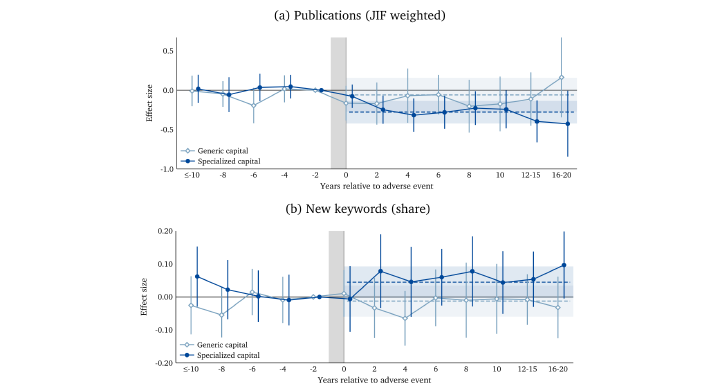
American Economic Journal — Applied EconomicsWe investigate the nature and relevance of physical capital in knowledge production. Exploiting adverse events in research laboratories, we find that scientists experience a persistent reduction in research output if they lose specialized physical capital—equipment and material they created over time for a particular research purpose. In contrast, they recover in productivity if they only lose generic physical capital. Scientists in older laboratories, who presumably lose more obsolete physical capital, are more likely to change their research direction and recover. These findings suggest that scientists’ investments into their own physical capital yield lasting returns but also create path dependence.
Finding Doppelgängers in Scopus: how to build scientists control groups using sosia
Rose M.E., Baruffaldi S.H. (2025)
Scientometrics
Finding Doppelgängers in Scopus: how to build scientists control groups using sosia
Rose M.E., Baruffaldi S.H. (2025)
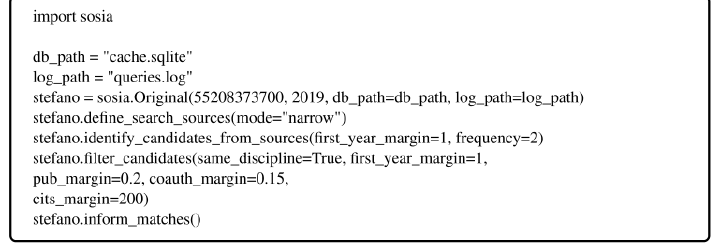
ScientometricsThe construction of control groups of scientists is often a daunting effort. This paper presents sosia, an open-source Python-based software designed to efficiently query the Scopus database via RESTful API. sosia searches for researchers with publication profiles similar to a given researcher up to a given year based on all main standard bibliometric indicators. The user can choose flexibly a set of parameters to restrict the search to more or less narrow boundaries upfront and obtain additional similarity indicators to select a subset of authors after the search. Advanced settings also allow narrowing the search to a list of affiliations and to minimize the possible errors arising from ambiguous author profiles. One basic search can be set up in a few command lines and the average time of computation goes between 60 and 300 minutes. We discuss the functioning, characteristics, limitations and possible extension of the software.
Like stars: How firms learn at scientific conferences
Baruffaldi S., Poege F. (2025)
Management Science
Like stars: How firms learn at scientific conferences
Baruffaldi S., Poege F. (2025)
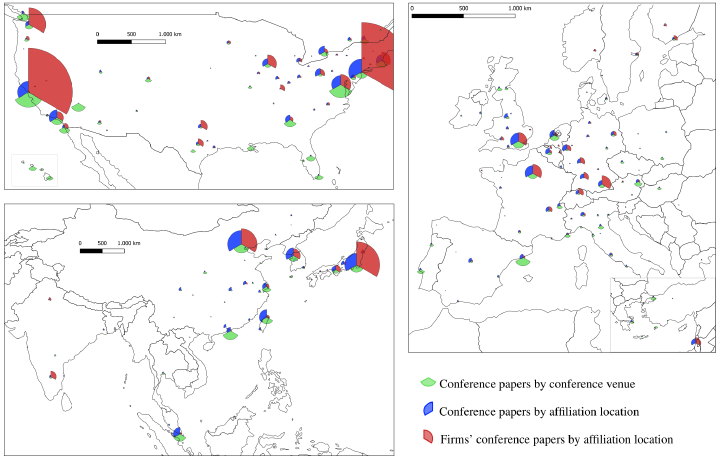
Management ScienceScientific conferences are an underexplored channel by which firms can learn from science. We provide empirical evidence that firms learn from scientific conferences in which they participate but also that this is conditional on intense participation. Using data from conference papers in computer science since the 1990s, we show that corporate investments in participation are both frequent and highly skewed, with some firms contributing to a given conference scientifically, some as sponsors, and some doing both. We use direct flights as an instrumental variable for the probability that other scientists participate in the same conference as a firm, altering the knowledge set to which the firm is exposed. We find that a firm’s use of scientists’ knowledge increases when they participate in the same conferences. Greater participation efforts, where the firm seeks the spotlight by both sponsoring the conference and contributing to its scientific discourse, foretell research collaborations and a stronger learning effect. Such learning is disproportionately concentrated among the most prominent firms and scientists rather than benefitting those without alternative interaction channels. Therefore, on average, firms learn from scientists that they encounter at conferences, but the substantial heterogeneity of the effect reflects the influence of reputation mechanisms in social interactions.
Asymmetric information and R&D disclosure: evidence from scientific publications
Baruffaldi S., Simeth M., Wehrheim D. (2024)
Management Science
Asymmetric information and R&D disclosure: evidence from scientific publications
Baruffaldi S., Simeth M., Wehrheim D. (2024)
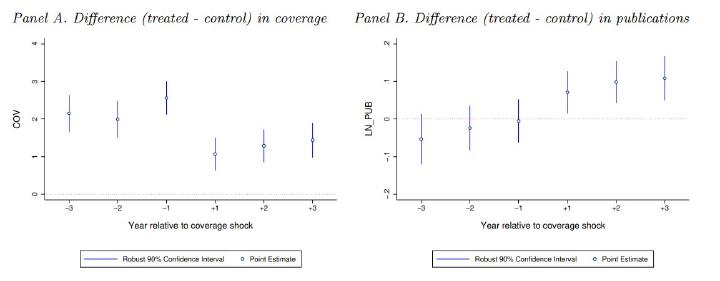
Management ScienceWe examine how asymmetric information in financial markets affects voluntary research and development (R&D) disclosure, considering scientific publications as a disclosure channel. Difference-in-differences regressions around brokerage house mergers and closures, which increase information asymmetry through reductions in analyst coverage, indicate a quick and sustained increase in scientific publications from treated firms relative to the number of publications from control firms. The treatment effects are concentrated among firms with higher information asymmetry and lower investor demand, firms with greater financial constraints, and firms with lower proprietary costs. We do not find evidence of changes in financial disclosure, nor do we find changes in patenting. Results from ordinary least squares regressions show that scientific publications by firms are positively associated with investor attention toward those firms. We complement these results with qualitative evidence from conference calls. Our results highlight the limitations and trade-offs R&D firms face in their financial market disclosure policies.
Money to move: The effect on researchers of an international mobility grant
Baruffaldi S.H., Marino M., Visentin F. (2020)
Research Policy
Money to move: The effect on researchers of an international mobility grant
Baruffaldi S.H., Marino M., Visentin F. (2020)
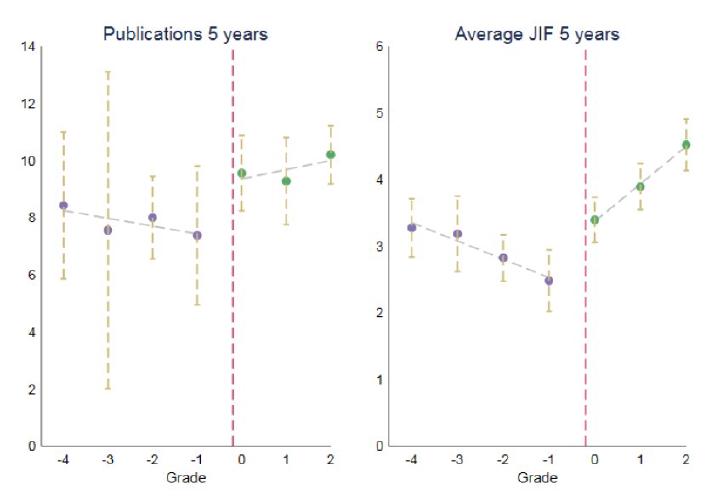
Research PolicyWe examine the impact of a grant program promoting international mobility on researchers’ scientific outcomes and careers. To provide causal evidence, we exploit unique data from the Swiss National Foundation and implement a Regression Discontinuity Design analysis. We find that the grant effectively supports periods of research abroad that often extend beyond the duration of the grant, without increasing the probability of permanent migration. Awarded researchers increase their output quality, although the effect on output quantity and careers is not significant. Additional evidence suggests that financing international mobility likely affects output quality by reducing the cost of exploring new collaboration opportunities and research topics: awarded applicants are more likely to collaborate with new coauthors of higher, on average, scientific quality and rely less on their previous own research results. Moreover, the grants mainly benefit researchers receiving a mobility grant for the first time.
Patents and knowledge diffusion: The effect of early disclosure
Baruffaldi S.H., Simeth M. (2020)
Research Policy
Patents and knowledge diffusion: The effect of early disclosure
Baruffaldi S.H., Simeth M. (2020)
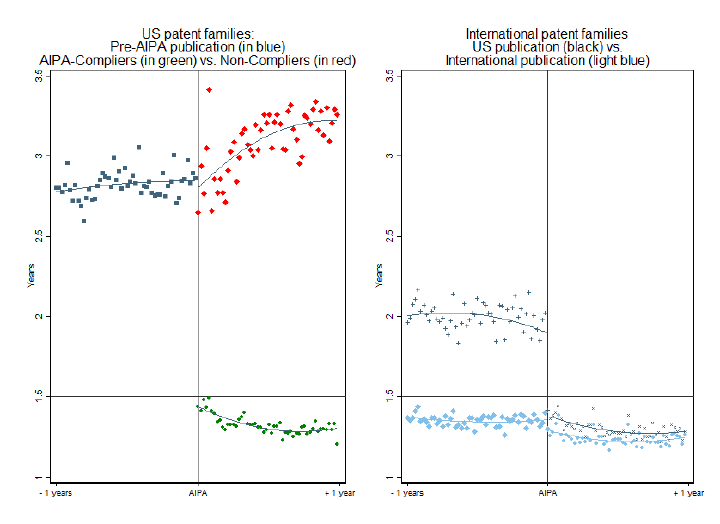
Research PolicyWe study how the timing of information disclosure affects the diffusion of codified technical information. On November 29, 2000, the American Inventors Protection Act (AIPA) reduced the default publication time of patents at the United States Patent and Trademark Office (USPTO) to 18 months. We analyze the effects of this change by means of a regression discontinuity design with time as an assignment variable and a complementary difference-in-differences analysis. Our study shows that information flows from patents measured by forward citations, increased. Interestingly, the degree of localization within geographic boundaries remained unchanged and technological localization even increased moderately. Moreover, the effect of early disclosure on citations from patents filed by patent attorney service firms is particularly strong. These results imply that knowledge diffusion stemming from speedier disclosure of technical information is confined to the existing attention scope and absorptive capacity of inventors and organizations.
Science quality and the value of inventions
Poege F., Harhoff D., Gaessler F., Baruffaldi S.H. (2019)
Science Advances
Science quality and the value of inventions
Poege F., Harhoff D., Gaessler F., Baruffaldi S.H. (2019)
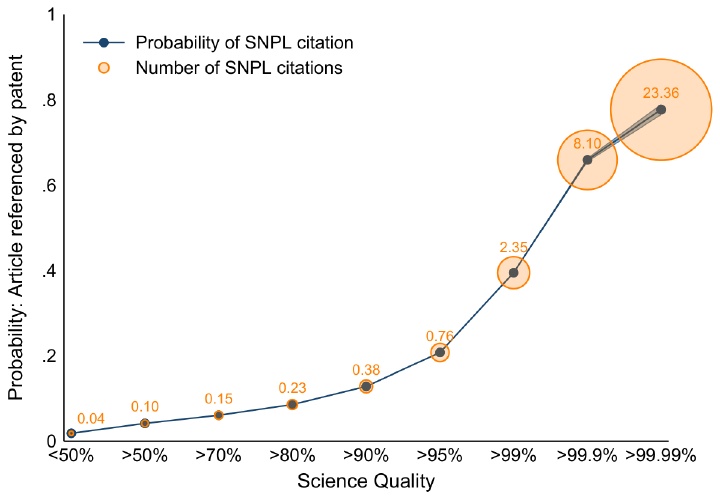
Science AdvancesDespite decades of research, the relationship between the quality of science and the value of inventions has remained unclear. We present the result of a large-scale matching exercise between 4.8 million patent families and 43 million publication records. We find a strong positive relationship between the quality of the scientific contributions referenced in patents and the value of the respective inventions. We rank patents by the quality of the science to which they are linked. Strikingly, high-ranking patents are twice as valuable as low-ranking patents, which, in turn, are about as valuable as patents without a direct science link. We show this core result for various science quality and patent value measures. The effect of science quality on patent value remains relevant even when science is linked indirectly through other patents. Our findings imply that what is considered excellent within the science sector also leads to outstanding outcomes in the technological and commercial realms.
Determinants of PhD holders' use of social networking sites: An analysis based on LinkedIn
Baruffaldi S.H., Di Maio G., Landoni P. (2017)
Research Policy
Determinants of PhD holders' use of social networking sites: An analysis based on LinkedIn
Baruffaldi S.H., Di Maio G., Landoni P. (2017)
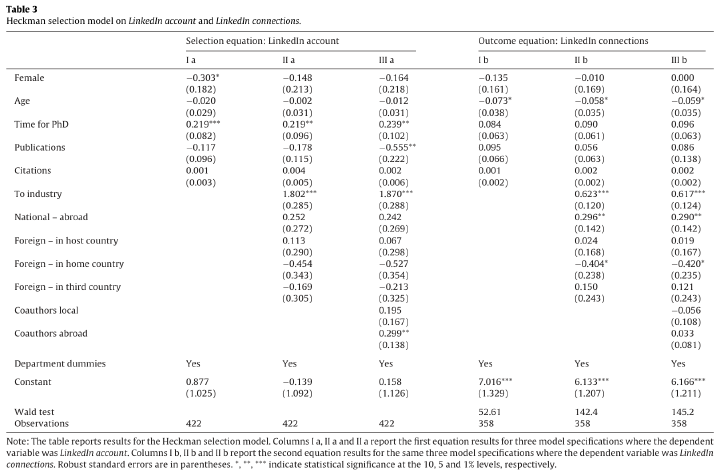
Research PolicySocial networking sites are an increasingly important tool for career development, especially for highly skilled individuals. Moreover, they may constitute valuable sources of data for scholars and policy makers. However, little research has been conducted on the use by highly skilled individuals of those social networks. In this paper, we focus on PhD graduates, who play an important role in the innovation process and in particular in knowledge creation and diffusion. We seek to increase understanding of the determinants that induce PhD graduates to register on LinkedIn and to develop wider or narrower networks. Controlling for the most relevant individual characteristics, we find that (i) PhD holders moving to the industry sector are more likely to have a LinkedIn account and to have a larger network of connections in LinkedIn; (ii) PhD holders are more likely to use LinkedIn if they have co-authors abroad; and (iii) they have wider networks if they have moved abroad after obtaining their PhD. In light of our analyses, we discuss the usefulness of — and main concerns about — the adoption of LinkedIn as a new data source for research and innovation studies.
The geography of duplicated inventions: evidence from patent citations
Baruffaldi S.H., Raffo J. (2017)
Regional Studies
The geography of duplicated inventions: evidence from patent citations
Baruffaldi S.H., Raffo J. (2017)
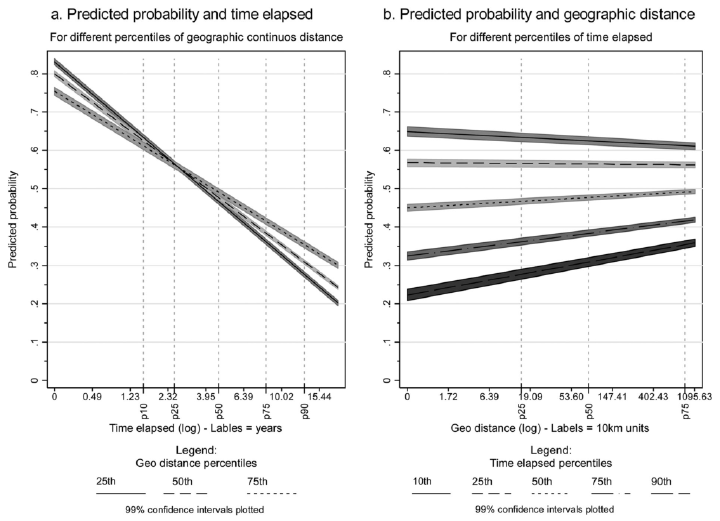
Regional StudiesInnovators often claim inventions that turn out to duplicate, at least in part, existing ones. This paper advances the claim that for recent and upcoming inventions, competitive incentives are high, and localized knowledge flows increase the probability of duplication. Therefore, over a brief period of time the probability of duplication is higher at short geographical distance. Conversely, the duplication of less recent inventions is more likely at long distance as a consequence of a lower awareness of the existence of a technology. This claim is supported by coherent descriptive and multivariate evidence using data on patent citation categories from the European Patent Office (EPO).
Mobility Intentions of Foreign Researchers: The Role of Non-economic Motivations
Baruffaldi S.H., Landoni P. (2016)
Industry and Innovation
Mobility Intentions of Foreign Researchers: The Role of Non-economic Motivations
Baruffaldi S.H., Landoni P. (2016)
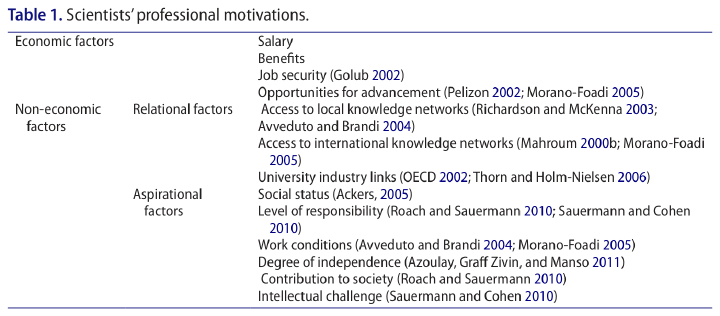
Industry and InnovationRecent contributions suggest that non-economic factors could be important motivational drivers of scientific mobility. We investigate this hypothesis in a sample of foreign researchers in Italy and Portugal, examining their willingness to leave the host country. We distinguish between economic factors, non-economic relational factors and non-economic aspirational factors. Controlling for the relevant contextual variables, we find that foreign researchers, unsatisfied with aspirational factors (e.g. level of independence, autonomy, intellectual challenge and social status), are more likely to leave their host country and move to a third country than they are to return to their countries of origin. Relational and economic factors, such as salary and benefits, do not demonstrate any additional impact.
Self-employment, start-up incentives and political ideology
Baruffaldi S.H., Marino M., Parrotta P. (2016)
Applied Economics Letters
Self-employment, start-up incentives and political ideology
Baruffaldi S.H., Marino M., Parrotta P. (2016)
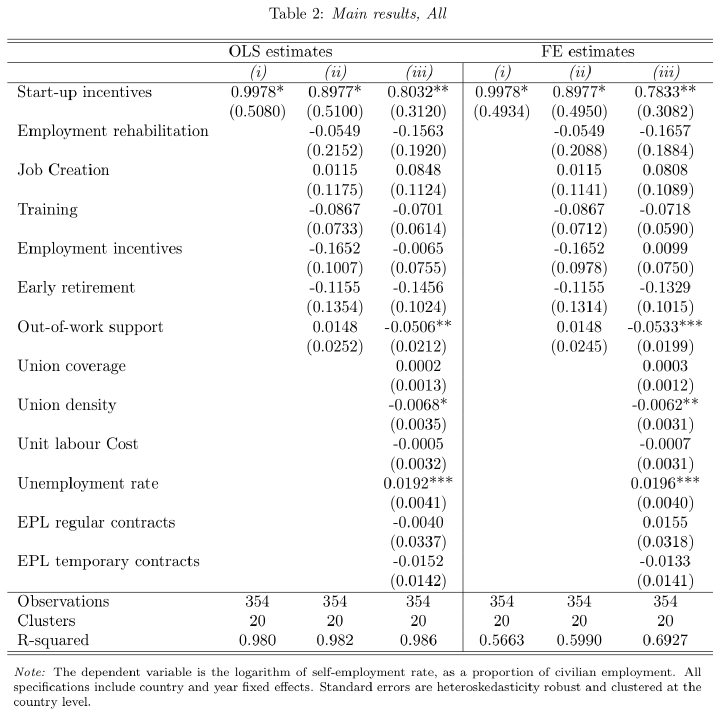
Applied Economics LettersWe find evidence that public start-up incentives promote self-employment. This public policy seems to affect more women than men.
The productivity of science and engineering PhD students hired from supervisors' networks
Baruffaldi S.H., Visentin F., Conti A. (2016)
Research Policy
The productivity of science and engineering PhD students hired from supervisors' networks
Baruffaldi S.H., Visentin F., Conti A. (2016)
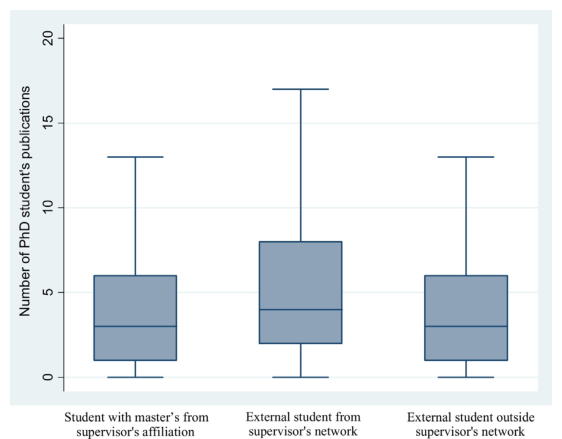
Research PolicyWe compare the scientific productivity of PhD students who are hired from a fine-grained set of mutually exclusive affiliation types: a PhD supervisor’s affiliation, an external affiliation from which the supervisor derives her coauthors, and an external affiliation with which the supervisor has no coauthorship ties. Using a novel dataset of science and engineering PhD students who graduated from two major Swiss universities, we find that the most productive PhD category is the one made of students who are affiliated with universities other than their supervisors’ affiliation, but from which the PhD supervisors derive their coauthors. This result suggests an inverted U-shaped relationship between PhD students’ productivity and the social distance from their supervisors. Additionally, we find evidence consistent with the role of supervisors’ coauthor networks in resolving information asymmetries regarding PhD talent.
Return mobility and scientific productivity of researchers working abroad: The role of home country linkages
Baruffaldi S.H., Landoni P. (2012)
Research Policy
Return mobility and scientific productivity of researchers working abroad: The role of home country linkages
Baruffaldi S.H., Landoni P. (2012)
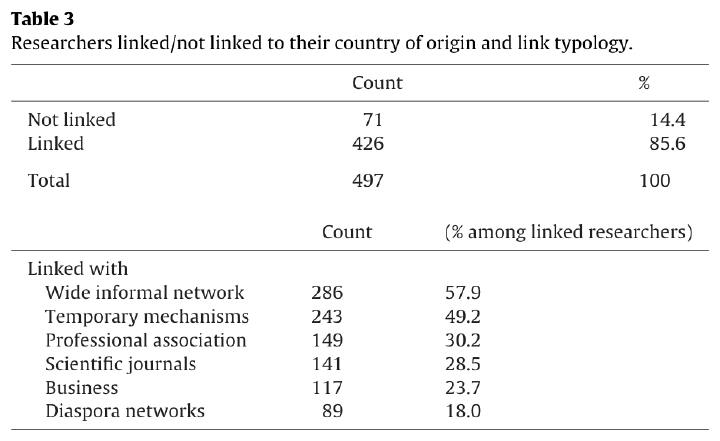
Research PolicyThrough an analysis of 497 foreign researchers in Italy and Portugal we verify the impact of home linkages on return mobility choices and scientific productivity. We consider the presence of several different types of linkages of the researchers working abroad with their country of origin and control for the most relevant contextual factors (age, research area, position in the host country, etc.). The probability of return to their home country and scientific productivity in the host country are both higher for researchers that maintain home linkages. We conclude that the presence of home linkages directly benefits both countries in addition to the indirect benefit of expanding the scientific networks. Policy implications and suggestions for further research are discussed.
Policy & other reports
Identifying and measuring developments in artificial intelligence: Making the impossible possible
Baruffaldi S.H., van Beuzekom B., Dernis H., Harhoff D., Rao N., Rosenfeld D., Squicciarini M. (2020)
OECD Science, Technology and Industry Working Paper
Identifying and measuring developments in artificial intelligence: Making the impossible possible
Baruffaldi S.H., van Beuzekom B., Dernis H., Harhoff D., Rao N., Rosenfeld D., Squicciarini M. (2020)
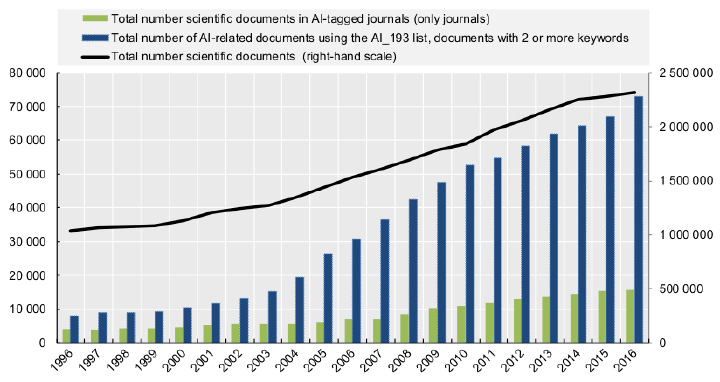
OECD Science, Technology and Industry Working PaperThis paper identifies and measures AI-related developments in science, algorithms and technologies using information from scientific publications, open source software (OSS) and patents. A three-pronged approach relying on established bibliometric and patent-based methods, and machine learning (ML) implemented on purposely collected OSS data, unveils a marked increase of AI-related developments over time. Since 2015, AI-related publications increased at 23% a year; in 2014-18, OSS commits related to AI grew about three times as other OSS contributions; in 2017 the share of AI-related IP5 patent families averaged more than 2.3%. The growing role of China in the AI space emerges throughout.