Ongoing research
Profiting from science: evidence from the valuation of AI startups
Bignone F., Baruffaldi S., Salter A. (2026)
Unpublished working paper
Profiting from science: evidence from the valuation of AI startups
Bignone F., Baruffaldi S., Salter A. (2026)
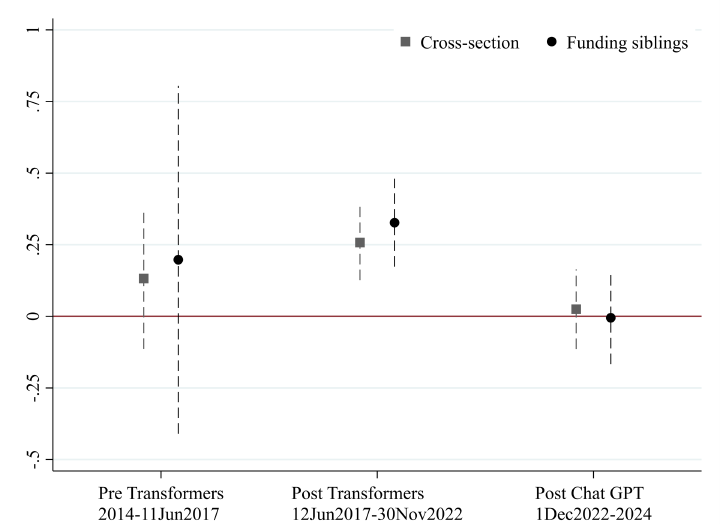
Unpublished working paperSome artificial intelligence (AI) startups engage with science, while others do not. Such engagement can distract from commercial goals or trigger disclosures, yet it may enable learning, network access, and legitimacy. We conceptualize scientific engagement as an entrepreneurial strategy during an industry’s incubation phase, characterized by weak appropriability and high technological opportunity. Using a unique dataset of UK AI startups, we measure engagement through multiple channels and document a positive association with valuation. Using a funding-sibling design—comparing startups backed by the same investor—we find engagement is associated with 19–32% higher valuations. This premium is stronger when startups engage across multiple channels. Finally, we explore how startup maturity and technology shocks shape this premium.
Research grant effects across funding modes and industry collaboration
Baruffaldi S., Lawson C., Seitz F. (2024)
R&R in Research Policy
Research grant effects across funding modes and industry collaboration
Baruffaldi S., Lawson C., Seitz F. (2024)
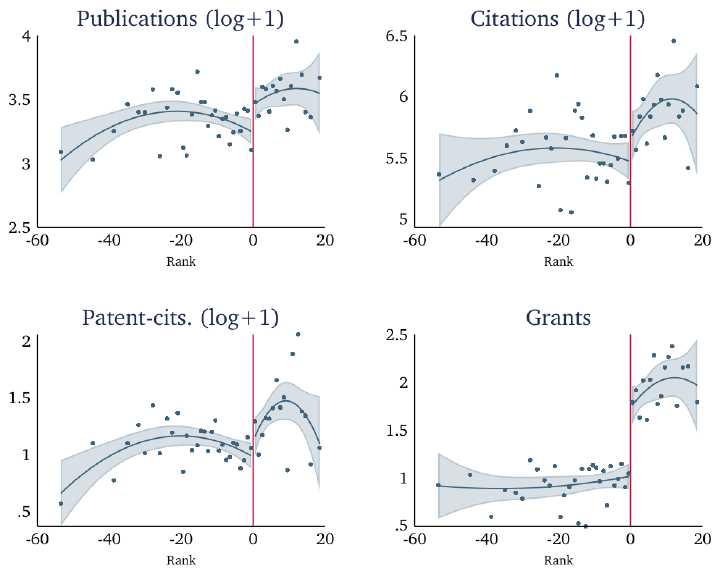
R&R in Research PolicyThe impact of public research funding remains debated, with limited evidence on how effects differ across funding modes. In this paper, we provide causal evidence on the impact of a major UK funder and use this setting to explore how its effects vary across institutional features. We implement a regression discontinuity design using novel data on more than 2,000 applications evaluated by the Engineering and Physical Sciences Research Council (EPSRC). We study the causal effect and examine differences between open, investigator-initiated schemes—characterised by greater researcher autonomy in defining research questions—and directional, funder-initiated schemes—which direct efforts toward predefined priorities. We further explore heterogeneities in how industry collaboration interacts with these funding modes. Our results show that investigator-initiated grants are associated with stronger subsequent performance advantage for funded researchers, but only when projects remain academically embedded. Directional grants, instead, exhibit more positive effects when combined with industry collaboration. While on average research grants have a substantial positive impact in our setting, their effects vary across key features, informing debates on the design of public science funding systems and highlighting the need for further research on the interplay between different funding characteristics.
Scientific paradigms, graphics processing units and the evolution of artificial intelligence
Baruffaldi S., Harhoff D., Liebnder-Luc A. (2024)
Unpublished working paper
Scientific paradigms, graphics processing units and the evolution of artificial intelligence
Baruffaldi S., Harhoff D., Liebnder-Luc A. (2024)
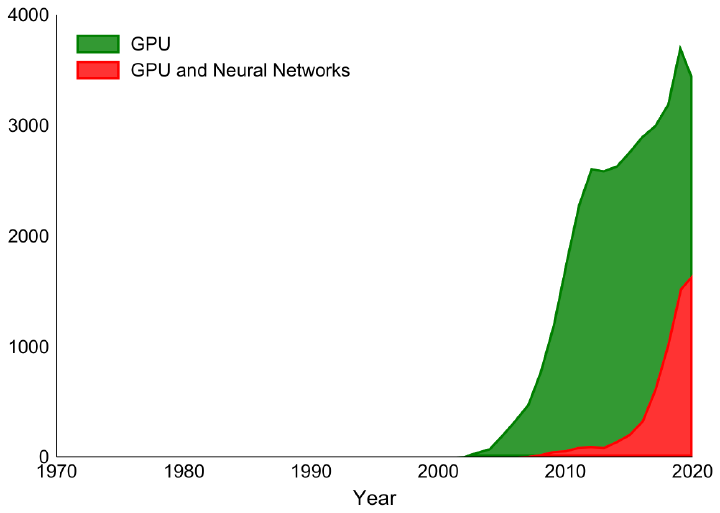
Unpublished working paperA sudden shift in scientific and technological paradigms lies at the heart of recent advancements in artificial intelligence (AI). Around 2012, traditional symbolic AI gave way to neural networks (NN) as the dominant approach for AI research. This coincided with the sudden successful application of graphics processing units (GPUs) as computational technology. GPUs had been invented for a different application, i.e. accelerating complex graphics displays, mostly in video games. We claim that these developments reflect the nature of breakthrough innovations and have implications for regions competing to become AI leaders. We investigate the role of expertise in GPUs for the uptake of AI innovation across regions globally. To this end, we construct a global database covering 2,088 urban areas for the period from 2000 to 2020. The data encompass a broad set of measures describing AI research and innovation activities, based on publications, patents and startups. We document the ascendancy of neural AI and its association with GPU expertise. Panel OLS and IV regressions demonstrate that after 2012 GPU- and NN-related human capital had a strong effect on the growth of AI-related patents and startups. We discuss implications for innovation policy.
The impact of mobility grants on researchers
Baruffaldi S., Santoleri P., Shevtsova Y. (2024)
Working paper
The impact of mobility grants on researchers
Baruffaldi S., Santoleri P., Shevtsova Y. (2024)
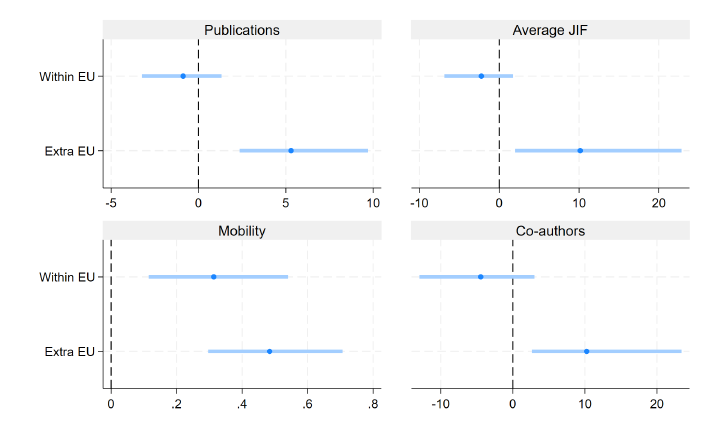
Working paperThe international mobility of researchers has long been promoted by public funding agencies, yet evidence on its effects remains limited. We study the Marie Skłodowska-Curie Individual Fellowships using data on all applicants to the EU’s Seventh Framework Programme (2007–2013). Exploiting a discontinuity in grant assignment, we identify the causal effects of receiving a fellowship. Grants substantially increase the likelihood that researchers move to their preferred destination. Moreover, grants supporting extra-European mobility, as opposed to those supporting mobility within Europe, raise publication quantity and quality and expand collaboration networks, suggesting higher returns where mobility frictions are larger.
Nobelwomen: status and gender balance in Science
Rose E.M., Rosendahl Huber L., Baruffaldi S.H. (2023)
Unpublished working paper
Nobelwomen: status and gender balance in Science
Rose E.M., Rosendahl Huber L., Baruffaldi S.H. (2023)
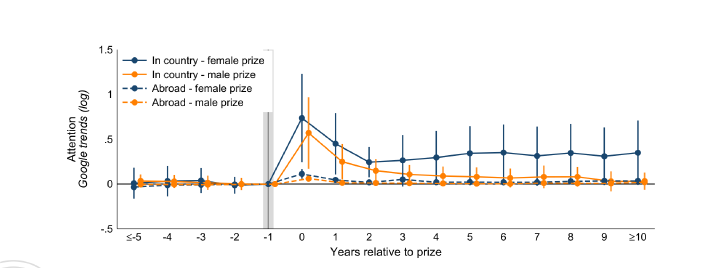
Unpublished working paperOne of the most important reasons for the under representation of female researchers in many academic disciplines is a masculine culture. Female role models can play an important role in changing the perceptions about a masculine domain leading to more interest and entry into these fields. In this paper we look at the long term effect of sudden role models, namely female awardees of prestigious prizes. To test our theoretical framework we use a unique longitudinal data set of a comprehensive population of 40 million active scientists since 1970. We find that after the first female prize winner in a certain country and field, the share of active female scientists in that country and field increases by 3 p.p. on average. Since the share of women in our sample is below 30% in most countries, this corresponds roughly to a 10% increase from baseline.
Fire and mice: the effect of supply shocks on basic science
Baruffaldi S.H., Byrski D., Gaessler F. (2020)
Unpublished working paper
Fire and mice: the effect of supply shocks on basic science
Baruffaldi S.H., Byrski D., Gaessler F. (2020)
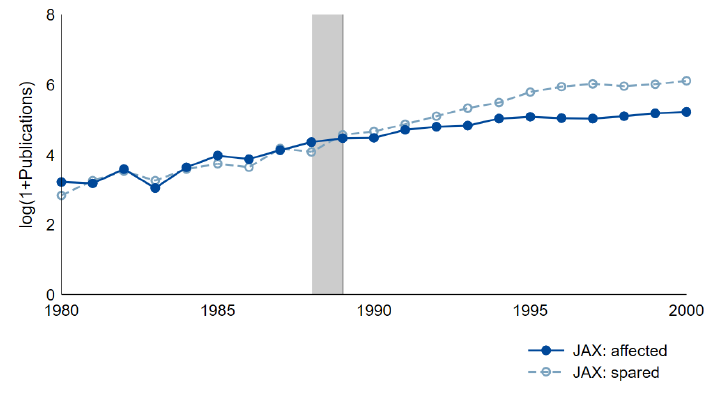
Unpublished working paperWe study how a negative supply shock to research-related assets affects the production of scientific knowledge. In particular, we exploit the 1989 Morrell Park fire that destroyed a considerable share of the world’s largest mice breeding facility, the Jackson Laboratory, and killed approximately 400,000 mice. This fire led to an unforeseen and substantial supply shortage in mice for the North American biomedical research community, which we can isolate at the strain and scientist level based on proprietary archival data. Using difference-in-differences estimations, we find that the scientific productivity of affected scientists decreases when measured in simple publication counts, but much less so when we adjust for the publications’ quality. Moreover, affected researchers are more likely to initiate research that is unrelated to their previous work. This indicates that affected scientists switched research trajectories but maintained their scientific impact. In the aggregate, the temporary supply shortage of particular mice strains led to a permanent decrease in their usage among U.S.\ scientists. These results highlight the important role of supply chains in basic science.